
If you're managing apartments, condos, hotels, assisted living units, or office breakrooms in Florida, you already know the problem. Cabinets can make an otherwise clean space look dated fast. The finish gets dull, corners chip, doors show grease and wear, and suddenly the whole unit feels older than it is.
The hard part isn't deciding that the cabinets need attention. It's figuring out how to upgrade them without taking units offline longer than necessary, blowing the budget, or creating a mess that disrupts tenants, guests, or staff. In occupied properties, cabinet work isn't just a finish issue. It's an operations issue.
That's where commercial cabinet refinishing in Florida makes sense. For many properties, the better question isn't "How do we make these cabinets look new?" It's "How do we improve appearance, protect the asset, and keep revenue moving?" Providers across Florida consistently market refinishing around fast completion and reduced mess, and that matters because for property managers, the primary decision often comes down to downtime risk, not just aesthetics. If your turnover calendar is tight, that can matter more than the cabinet box itself.
A refinishing-first approach also fits properties that need staged work, selective upgrades, or recurring refreshes across multiple units. For hospitality and large residential portfolios, it's often smarter to improve what you already own than tear everything out. Teams that handle resort and hospitality environments already work within those constraints, which is why this kind of hotel and theme park cabinet refinishing work is relevant to commercial owners planning around occupancy.
Table of Contents
- Updating Commercial Properties Without The Downtime
- Refinish vs Replace Analyzing Your ROI
- The Professional Refinishing Process and Timeline
- Coatings and Durability for Florida Properties
- Managing Site Logistics Dust and Odor Control
- View Our Work and Get Your Project Quote
Updating Commercial Properties Without The Downtime
Most commercial cabinet projects start the same way. A leasing team says the units show well except for the kitchen. A hotel owner sees that guest room millwork still functions, but the finish looks tired. An office manager wants the breakroom cleaned up without turning a simple upgrade into a renovation schedule.
Cabinet replacement can solve the visual problem, but it often creates a bigger operating problem. Demolition, hauling, delivery coordination, install delays, countertop disconnects, and punch-list issues can stretch a simple update into a drawn-out disruption. In income-producing properties, every extra day affects rent continuity, booking flow, or staff use of the space.
Why refinishing fits commercial turnover cycles
Refinishing works when the cabinet layout is still serviceable and the goal is to improve appearance, extend usable life, and keep the room operational. That's why this approach shows up again and again in rentals, hospitality settings, and condo turnovers. You're keeping the existing boxes, avoiding a full tear-out, and focusing labor where the visual change is most visible.
Practical rule: If the cabinet structure is solid, the fastest path to a better-looking space usually isn't replacement. It's a controlled refinishing process with a schedule built around occupancy.
The business value is straightforward. You preserve continuity. You reduce disruption. You upgrade the look of the room without reopening every adjacent trade.
Where the decision gets made
For commercial owners, the decision usually isn't made in the showroom. It's made on the turnover calendar.
A property manager doesn't just ask whether a new door style would look better. They ask whether the unit can be back in service fast, whether work can be phased, and whether the process will create dust, odor, or scheduling problems for neighboring spaces. That's why commercial cabinet refinishing in Florida is less about vanity and more about execution.
Refinish vs Replace Analyzing Your ROI
When owners compare cabinet options, they often look only at the upfront invoice. That's incomplete. ROI comes from balancing initial cost, time out of service, finish quality, and how long the result stays presentable under daily use.
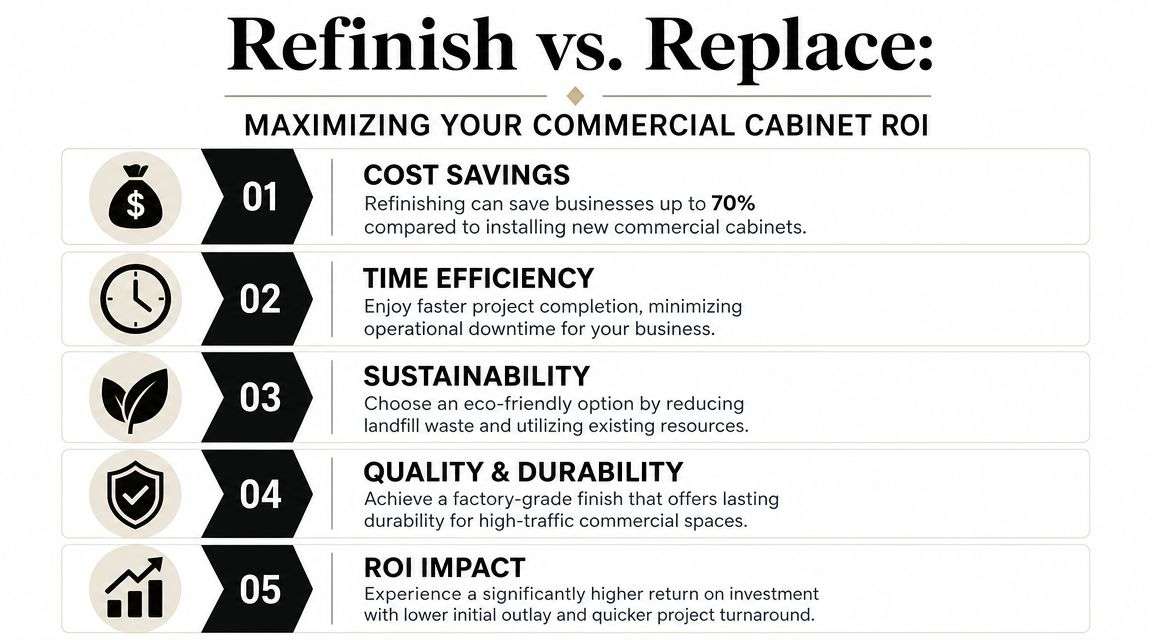
Professional refinishing is often the budget-conscious move. Industry guidance puts cabinet refinishing at about 50% to 70% less than full replacement, with a national average around $3,114 for refinishing versus $25,000 or more for replacement, and South Florida estimates commonly landing in the $1,500 to $5,000 range for professional kitchen cabinet refinishing. If you're weighing a tear-out, it's worth reviewing the broader replacement picture in this guide on what it costs to replace cabinets.
What each option really buys you
Not every cabinet update category solves the same problem. Here's the cleaner way to compare them.
| Metric | Professional Refinishing | Cabinet Refacing | Full Replacement |
|---|---|---|---|
| Primary use case | Existing cabinets are structurally sound but visually dated or worn | Boxes stay, exterior surfaces and door faces get a more substantial visual update | Layout, cabinet boxes, or function need to change |
| Initial investment | Commonly the lowest of the three when cabinets are worth saving | Mid-range, with cost changing heavily by material and scope | Usually the highest due to demolition, disposal, new cabinetry, and installation |
| Downtime impact | Usually best suited to faster turnarounds and lower disruption | Moderate, depending on door production, material lead times, and site conditions | Highest disruption because it affects more trades and more parts of the room |
| Best ROI scenario | Rentals, occupied condos, hospitality rooms, offices, and turnovers with sound boxes | When the owner wants a bigger style shift but still wants to avoid full replacement | When cabinets are failing structurally or the room layout must change |
| Operational complexity | Lower, especially if doors and drawers are handled off site | Moderate | Highest |
Where property managers lose money
They lose it in the gaps between trades and in the wrong scope.
A common mistake is choosing replacement when the boxes are still solid. Another is hiring for a low-cost cosmetic paint-over that looks acceptable at handoff but fails early around pulls, edges, sink bases, and cleaning zones. Commercial environments expose weak prep quickly.
Cabinet refacing can make sense, but pricing can move a lot depending on material choice and project size. In Miami cost guides, average refacing estimates are listed at $1,443 to $1,791, larger projects can rise to $7,000 to $10,000, laminate refacing is estimated around $1,356 to $2,099 for a standard 10-by-12 cabinet set, and wood veneer can run $2,000 to $6,000. That spread is why owners need to decide what matters most: appearance change, service life, or speed back to occupancy.
The cheapest line item isn't always the lowest-cost decision. If the finish fails early or the project extends turnover, the savings disappear.
For most commercial properties, the ROI framework is simple:
- Choose professional refinishing when the boxes are sound and downtime is the primary cost.
- Choose refacing when you need a bigger exterior style change and the budget can absorb a wider material spread.
- Choose replacement only when function, layout, or structural condition makes saving the existing cabinetry a poor decision.
Commercial ROI isn't only about cabinet cost
Managers who handle recurring turnovers think in cycles. If one method lets you update kitchens and bath vanities with less disruption, it can be repeated property-wide with fewer surprises. That's useful for apartment portfolios, condo associations, and hospitality groups that need a repeatable spec instead of a one-off remodel mindset.
The strongest cabinet strategy is the one that aligns with how the property operates.
The Professional Refinishing Process and Timeline
A professional cabinet refinish isn't just paint applied to old doors. The outcome depends on prep, coating choice, where the work is done, and how the project is sequenced. That's what separates a finish that holds up from one that starts failing after cleaning, humidity exposure, and repeated use.
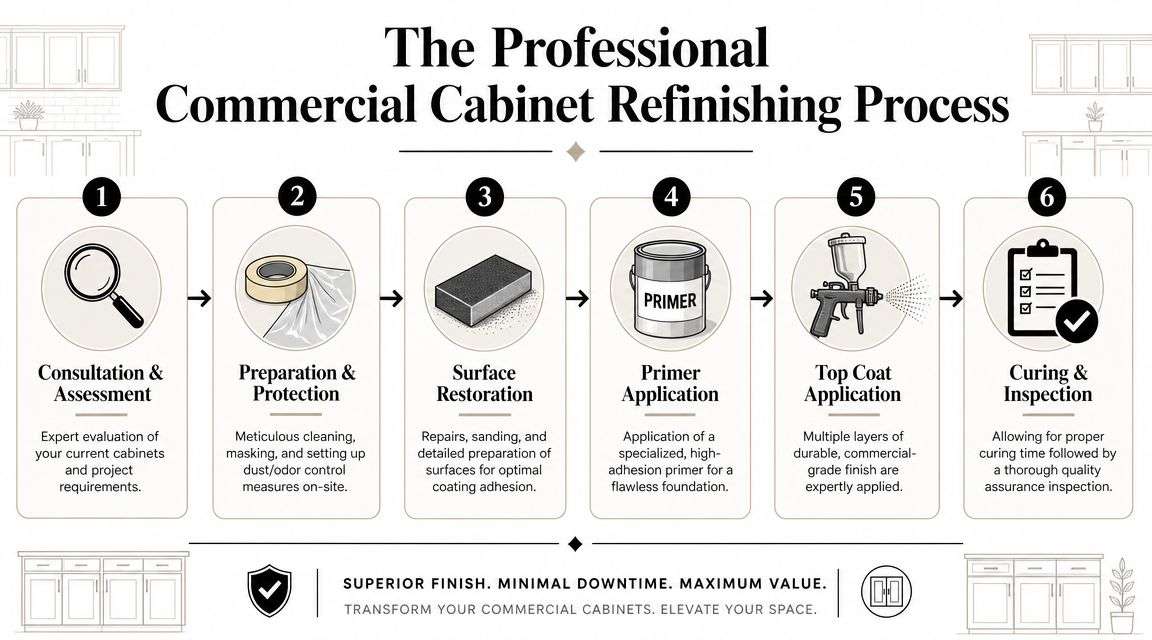
Industry process guidance is consistent on the fundamentals. A professional-grade result comes from a sprayed enamel or urethane system, not brushing or rolling. Doors and drawer fronts are typically removed, then cleaned, sanded, and sealed with a bonding primer before topcoats are applied because skipping adhesion prep increases the risk of peeling and early failure (professional cabinet refinishing process guidance).
What happens on site
For occupied or fast-turn properties, the workflow needs to control disruption as much as it controls finish quality.
A typical commercial sequence looks like this:
Assessment and scope check
The crew verifies that the cabinet boxes are worth saving, identifies damaged areas, confirms sheen and color expectations, and plans around occupancy.Masking and protection
Floors, counters, appliances, adjacent walls, and traffic paths get protected. In commercial spaces, this step matters because the job site often sits inside an otherwise active property.Door and drawer front removal
Hardware is documented, components are labeled, and removable parts are taken off so they can be finished under more controlled conditions.Cleaning and degreasing
Kitchen and breakroom cabinets collect contamination that paint won't stick to. Grease, hand oils, and old cleaners must be removed before sanding and priming.
Why the finish looks different from a paint job
A proper refinish builds from surface preparation, not color alone.
After cleaning, surfaces are sanded and repaired as needed. Then a bonding primer is applied to create adhesion between the existing substrate and the finish system. Only after that do the topcoats go on. The reason professionals spray instead of brush or roll is simple: spray application gives a more even film build and a smoother, more uniform sheen.
A cabinet can be the right color and still look wrong. Texture, lap marks, dry spray, and uneven build are what make a quick repaint look cheap.
Commercial owners should also ask where the spraying happens. When removable parts are finished away from the active room, crews can control dust, overspray, and cure conditions better. That usually produces a cleaner final product and a calmer job site.
What timeline expectations should look like
In South Florida cost guidance, cabinet refinishing timelines are commonly described as about 2 to 3 days for a typical project, with labor often running $35 to $75 per hour. Actual scheduling for commercial work depends on access, occupied status, the amount of prep required, and whether the project is phased across multiple units.
Resurrect Wood Refinishing handles cabinet refinishing as a refinishing-focused service rather than a basic repaint, which is the right model for owners who care about smooth film build, adhesion, and repeatable results across similar units.
Coatings and Durability for Florida Properties
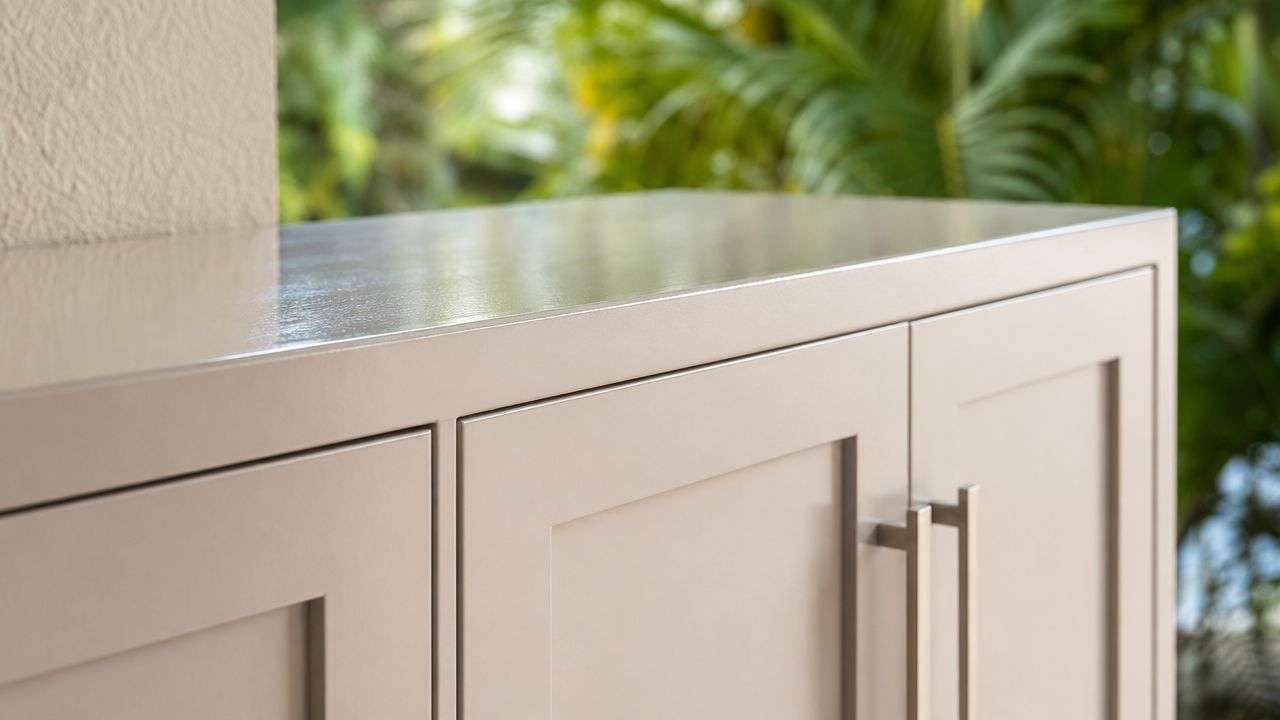
Florida is hard on finishes. Humidity hangs in the air. Coastal environments introduce extra stress. Rental kitchens and hospitality spaces get wiped down often, bumped often, and judged quickly by incoming tenants and guests. If the coating system is weak, the failure usually shows up first at corners, door edges, sink bases, and high-touch areas around pulls.
Why Florida is hard on cabinet finishes
A lot of owners focus on color and ignore chemistry. That's backwards in this climate.
The finish has to bond well, resist repeated cleaning, and stay intact in damp interior conditions. Service pages in Florida often promise a factory-like appearance, but appearance isn't the ultimate test. The critical test is whether the coating keeps adhering after use, moisture exposure, and routine maintenance.
What holds up better in commercial use
For humid, high-traffic settings, the coating system matters as much as the prep. High-performance catalyzed coatings are designed for stronger durability, chemical resistance, and adhesion, which helps prevent the kind of premature failure that shows up with lower-grade products in coastal and moisture-prone environments.
That doesn't mean every cabinet needs the same finish schedule. A private office kitchenette doesn't get used like a hotel wet bar. A long-term rental doesn't get cleaned the same way a short-stay unit does. But the rule is consistent: the harsher the environment, the less sense it makes to save money on coating quality.
Field observation: In Florida properties, poor prep and the wrong coating usually fail before the color goes out of style.
For commercial cabinet refinishing in Florida, ask direct questions:
- What coating system is being specified for boxes, doors, and drawer fronts?
- How is adhesion being built over the existing surface?
- What areas are most likely to fail first, and how are they being addressed?
- How should staff clean the finished cabinets so the coating lasts?
Cheap bids usually hide future maintenance
Owners sometimes compare bids as if they all describe the same process. They don't.
One proposal may include full cleaning, sanding, bonding primer, and a high-performance sprayed system. Another may be little more than cosmetic coating over marginal prep. On day one, both can look acceptable in photos. After regular use, they won't age the same way.
For commercial spaces, durability isn't a luxury feature. It's what keeps the first job from turning into another job too soon.
Managing Site Logistics Dust and Odor Control
Commercial owners don't just buy a finish. They buy a work plan. If the site logistics are sloppy, even a decent coating system becomes a management problem. Tenants complain, staff loses access, dust spreads, and the schedule slips because nobody planned the job around how the building functions.
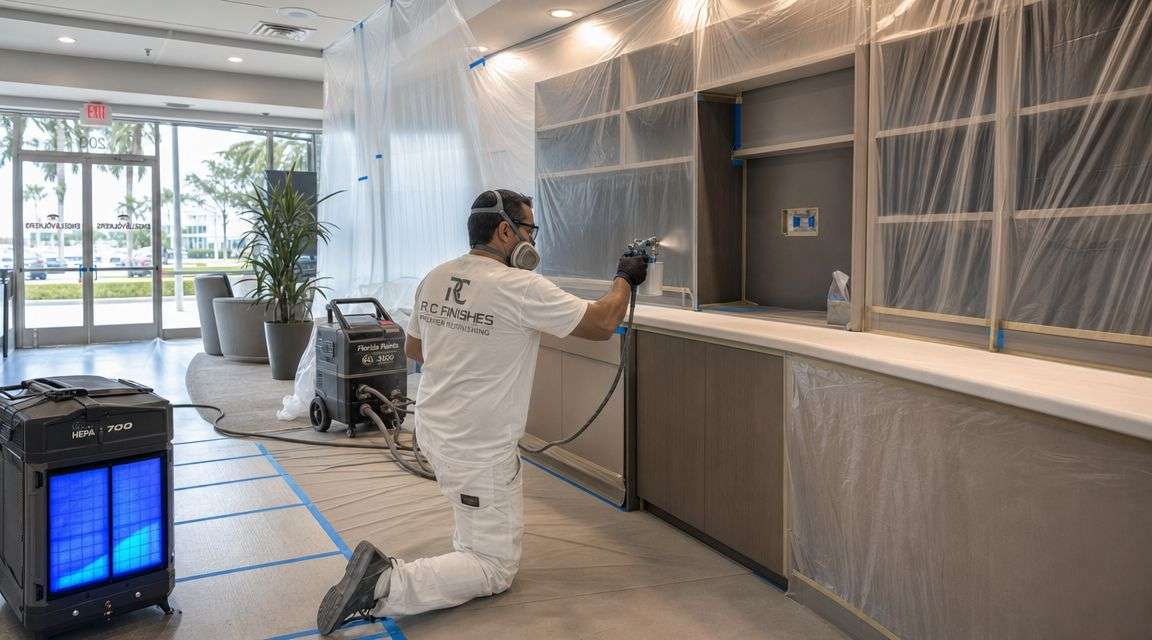
Occupied properties need a containment plan
The practical way to keep disruption down is to separate what must happen on site from what doesn't.
Cabinet boxes may need site prep, masking, sanding, and finishing work in place. Doors and drawer fronts, on the other hand, are often better handled away from active living or guest spaces when the workflow allows. That reduces overspray risk and helps control odor inside the property.
A disciplined site plan usually includes:
- Full masking of adjacent surfaces so dust and coating residue don't migrate into finished areas
- Isolated work zones that keep the cabinet area separate from traffic paths
- Tool-connected dust extraction during sanding and prep
- Sequenced access planning so staff or tenants know exactly when a kitchen, vanity, or breakroom is limited
Good cabinet work in occupied space looks quiet from the outside. That only happens when masking, sequencing, and cleanup are treated as part of the craft.
Phasing matters more than most owners expect
In commercial properties, the best schedule often isn't the fastest all-at-once schedule. It's the one that keeps the building usable.
That may mean working unit by unit, floor by floor, or amenity space by amenity space. It may also mean scheduling removals and reinstallations around cleaning crews, maintenance, inspections, and turnover deadlines. A refinishing contractor who understands commercial work should be able to discuss staging before discussing color.
Budget decisions also tie back to logistics. Material choices can change cost and scope significantly. In Miami, cabinet refacing costs range from around $1,356 for laminate to over $6,000 for wood veneer on a standard kitchen, which shows how quickly appearance choices can shift the budget and complicate planning. For property managers, that makes a simpler, durable refinishing scope attractive when the priority is reliable scheduling rather than a more elaborate rebuild of the exterior surfaces.
What to ask before approving work
Before you greenlight a commercial cabinet project, get operational answers in plain language:
- Which parts of the job happen on site and which happen off site
- How the crew will contain dust and protect adjacent finishes
- Whether work can be phased to match occupancy or turnover
- How odor will be managed during prep, coating, and cure
- What the handoff looks like for cleaning, inspection, and punch items
If a contractor can't explain the site plan clearly, don't assume the project will somehow run smoothly once it starts.
View Our Work and Get Your Project Quote
The most useful cabinet portfolio for a property manager isn't a gallery of pretty kitchens. It's proof that worn cabinets can be turned into clean, current-looking assets without unnecessary disruption.
What a smart cabinet refresh looks like in practice
In an apartment turnover, that might mean taking a dark, greasy kitchen with sound cabinet boxes and giving it a lighter, smoother finish that photographs better for leasing and feels cleaner during showings. In a boutique hotel, it might mean refreshing guest room vanities and service cabinetry so the property looks maintained without pulling rooms out of service for a full millwork replacement. In an office breakroom, it could be as simple as updating tired cabinets so the space stops dragging down the rest of the renovation.
Those are different properties, but the logic is the same. Keep what still works. Upgrade what guests and tenants see. Avoid turning a contained finish project into a broad renovation.
You can review examples of finished cabinet and wood refinishing projects in the Resurrect Wood Refinishing portfolio.
How to scope the project before you call
A useful quote starts with clear operating facts. Before reaching out, gather:
- Property type and use so the finish can match traffic and cleaning demands
- Cabinet condition including peeling, swelling, broken doors, or damaged drawer fronts
- Scheduling constraints such as tenant occupancy, guest bookings, inspections, or turnover dates
- Visual goals including color direction, sheen preference, and whether hardware is changing
That makes the conversation more productive. Instead of talking in generalities, you can discuss scope, sequence, and whether the cabinets should be refinished, selectively rebuilt, or replaced.
Commercial cabinet refinishing in Florida works best when it is treated as an asset-protection and continuity decision. The right process improves appearance. The better outcome is that the property keeps moving while the upgrade happens.
If you're planning a cabinet upgrade for rentals, hospitality spaces, offices, or condo units, Resurrect Wood Refinishing can help you evaluate the practical path forward. Ask for a project quote based on your cabinet condition, occupancy schedule, finish goals, and turnover timeline so you can compare refinishing against more disruptive options with a clear scope in hand.
